
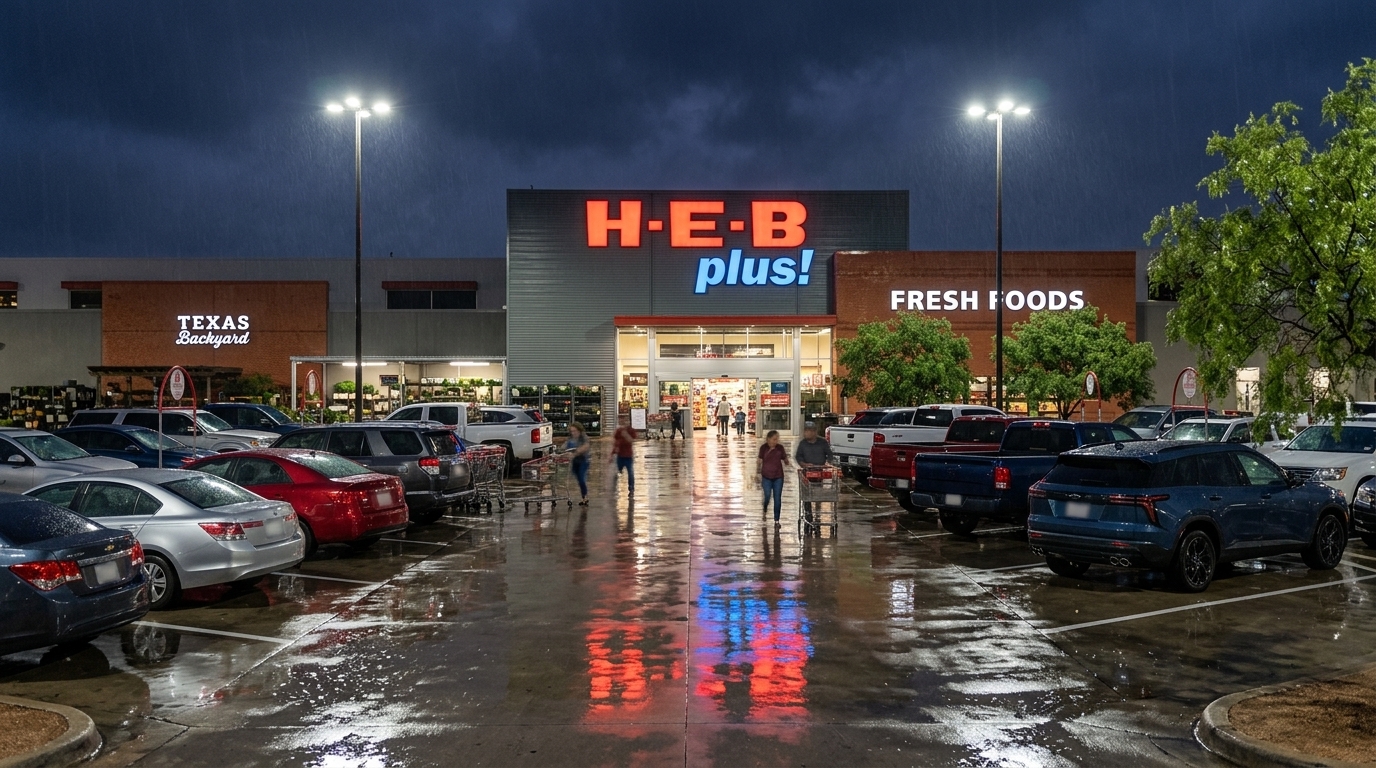
H-E-B, headquartered in San Antonio, Texas, is a privately held American supermarket company. Founded in Kerrville in 1905 by Florence Butt, the company operates stores throughout Texas and Mexico. Its retail formats include H-E-B supermarkets, Central Market, H-E-B Plus!, Mi Tienda and Joe V’s Smart Shop. Known for its strong Texas identity and emphasis on fresh products, private-label innovation, and community engagement, H-E-B has evolved from a single family-owned neighborhood grocery into a major regional supermarket chain operating a diverse portfolio of brands tailored to different customer segments and market needs.
H-E-B is focused on delivering customer experience, and its growth has made it a significant force in southwestern grocery retail. The company operates multiple store formats at different price points and service levels, from discount Joe V’s Smart Shop locations to upscale Central Market stores, allowing it to compete across market segments. H-E-B’s private label program is a core pillar of its success, with its “Own Brands” having become synonymous with quality and value. The company has become known for using its logistics network during natural disasters in Texas, deploying mobile kitchens, water tankers and other emergency resources during hurricanes and the 2021 Texas power crisis.
History
Florence Butt opened Mrs. C. C. Butt’s Staple and Fancy Grocery on the ground floor of her family’s home in Kerrville on November 26, 1905. Her youngest son, Howard Edward Butt, took over management of the store in 1919. After unsuccessful early attempts to expand into Central Texas, Butt opened a successful store in Del Rio in 1926, followed in 1927 by the purchase of three grocery stores in the lower Rio Grande valley. By specializing in low-priced goods the company survived the Great Depression so successfully that Butt was able to introduce employee picnics and a group life-insurance policy, move company headquarters to the Rio Grande valley, and expand to nearly twenty stores in Southwest Texas, with a gross business of $2 million in 1931.
The company adopted the name H.E. Butt Grocery Company in the mid-1930s. H-E-B acquired the Harlingen Canning Company and opened a bakery in Corpus Christi in 1936. The company’s headquarters moved to Corpus Christi in 1940. In 1942, it opened its first store using the H-E-B name in San Antonio. The company expanded its stores into supermarkets during the 1950s and opened a manufacturing and distribution complex in San Antonio in 1964.
Charles Butt, a grandson of Florence Butt, became president of the company in 1971. H-E-B moved its headquarters to the former San Antonio Arsenal on the San Antonio River in 1985. The H-E-B Pantry Foods format, introduced in 1988, extended the chain into East and North Texas.
H-E-B opened the first Central Market in Austin in 1994, a specialty-grocery format emphasizing fresh, international and specialty foods. H-E-B introduced H-E-B Plus! in 2004, initially opening locations in Austin, Corpus Christi and Waco, using larger stores with expanded general-merchandise and nonfood selections in addition to groceries. H-E-B launched Mi Tienda in the Houston area in 2006, a format focusing on Mexican and Latin American foods and using design elements intended to evoke a traditional Mexican market.
H-E-B entered Mexico in 1997 with the opening of H-E-B Chipinque in the Monterrey area. The company opened its first distribution center in Nuevo León in 2004 and introduced online grocery shopping in Mexico in 2015.
In 1983, San Antonio grocery chain Handy Andy filed a $140 million antitrust lawsuit accusing H-E-B of predatory pricing; Handy Andy settled its claims in 1985, while Centeno continued its case in federal court before settling in 1988. In 2014, H-E-B paid $12 million to settle a whistleblower lawsuit alleging that it had submitted inflated prescription prices to Texas Medicaid and received reimbursements exceeding those permitted under the program.
In 2015, H-E-B established the Partner Stock Plan, through which eligible employees could receive shares in the privately held company. In February 2018, H-E-B acquired Austin-based Favor Delivery for an undisclosed amount. Howard Butt III became chief executive officer in 2021, while Charles Butt remained chairman. In 2025, H-E-B announced that Roxanne Orsak would succeed Craig Boyan as president in January 2026 while retaining her position as chief operating officer.
Operations & Footprint
The company’s expansion into the Houston marketplace began in 1992 with the H-E-B Pantry concept, with the modern H-E-B era beginning in 2001 with the first larger, full-service H-E-B format. H-E-B maintained a presence in the Dallas–Fort Worth metroplex through Central Market and other formats before beginning a major expansion of its namesake H-E-B supermarkets into the region in 2022, with the first namesake H-E-B in the DFW Metroplex opening in Frisco on September 21, 2022, followed by a store in Plano on November 2. In June 2026, an H-E-B in Irving became the company’s first namesake supermarket in Dallas County. In May 2026, the Dallas City Council approved plans for the first namesake H-E-B supermarket within the city of Dallas, with construction expected to begin in 2027.
H-E-B’s operations are concentrated in Texas and northern Mexico. H-E-B México states that it operates 87 stores in the country and employs more than 18,000 people. By July 2026, Joe V’s had 14 locations statewide: 11 in the Houston region and three in North Texas. True Texas BBQ is a barbecue-restaurant concept located inside selected H-E-B stores, with the 50th True Texas BBQ location opening inside the H-E-B store in Euless in May 2026.
H-E-B maintains an employee stock ownership program established in 2015. Its retail formats include H-E-B supermarkets, Central Market, H-E-B Plus!, Mi Tienda and Joe V’s Smart Shop. H-E-B also owns the delivery service Favor Delivery.
Products, Services & Merchandising
H-E-B has a tiered own brand strategy, with its premium H-E-B brand often matching or exceeding the quality of national brands, while its Hill Country Fare brand provides a value-focused option. Own Brands include H-E-B Select Ingredients, H-E-B Organics, H-E-B Meal Simple, Field and Future by H-E-B, Mi Tienda, Hill Country Fare, Central Market, H-E-B Kitchen & Table, H-E-B Responsibly Raised and H-E-B Texas Roots. Customers will also find Home by H-E-B brands Haven + Key and Texas Proud, along with True Texas Barbecue restaurants, in many H-E-B stores.
H-E-B’s “Select Ingredients” initiative removes artificial additives in many private-label foods, appealing to shoppers who want cleaner options without the higher price tag. Central Market is known for its upscale shopping experience and gourmet offerings, including an abundance of fresh and unique produce, specialty items such as European chocolates, hundreds of local and imported cheeses and small batch wines, and offers cooking classes, coffee bars using local roasters, and freshly prepared foods.
H-E-B opened the first Joe V’s Smart Shop in Houston in 2010, a discount format that operates smaller stores than typical H-E-B supermarkets and carries a narrower assortment, with some merchandise displayed on pallets to reduce operating costs. Its store in Meyerland, recognized as the historic and cultural hub of Houston’s Jewish community, stocks the largest assortment of kosher goods in the state.
Work Environment & Employment
In January 2016, eligible Partners received a grant of stock valued at 3 percent of their salary, plus $100 in stock value for each year of continuous service completed by the end of 2015, with yearly contributions to the stock plan made based on company performance going forward. This grant enhances the long-term financial security of Partners and is offered in addition to all of H-E-B’s existing compensation programs including a 401(k) plan that includes a company match. More than 25 percent of H-E-B’s employees have been with the company for more than 10 years and thousands are 20-plus year employees.
According to the Handbook of Texas, the company has historically donated about 5% of its pretax earnings to civic and charitable organizations. H-E-B has a long history of charitable giving in the communities where it operates.
Business Model & Financial History
H-E-B operates as a privately held company, with ownership and control maintained by the founding family since its inception. The Butt family retains control of the company, with Forbes estimating its ownership at 87% in 2026. The company’s business model reflects typical grocery industry economics: thin operating margins offset by volume, dependence on scale and supply-chain efficiency, and competitive positioning through private-label penetration and format diversification.
H-E-B’s tiered own brand strategy has led to a significant portion of sales coming from private label products, with profit margins that are significantly higher than national brands. The company has built structural advantages through decades of manufacturing and logistics investment, operating multiple distribution centers and food-production facilities across Texas and Mexico. In addition to its retail operations, H-E-B manufactures private-label food products and operates warehouses and distribution facilities. In 2026, H-E-B proposed a $700 million expansion of its manufacturing and distribution complex on the east side of San Antonio, which included plans for a bakery, refrigerated warehouse, transportation building and an expansion of an existing manufacturing facility, with projections that the investment would add 720 jobs by 2028.
Competitive Landscape
H-E-B operates in a highly fragmented and competitive grocery market dominated nationally by Walmart and Kroger, but maintains regional strength in Texas and parts of Mexico through differentiation and community presence. H-E-B’s aggressive expansion into North Texas, one of the most competitive grocery markets in the country, accelerated in 2025, with the company’s presence previously concentrated in other parts of the state. The company’s portfolio of banners—each targeting different demographics and price points—provides insulation against discount competitors such as Aldi and Trader Joe’s, as well as upscale operators such as Whole Foods.
In Mexico, H-E-B competes with established multinational retailers including Walmart (Walmex) and regional chains such as Soriana. H-E-B’s operations are concentrated in Texas and northern Mexico, where the company has achieved significant scale while adapting to local customer preferences and product availability.
Recent Developments & Outlook
H-E-B began a major expansion of its namesake H-E-B supermarkets into the Dallas–Fort Worth region in 2022, with the first namesake H-E-B in the DFW Metroplex opening in Frisco on September 21, 2022, followed by a store in Plano on November 2. This expansion marks the company’s largest geographic push outside its traditional south and central Texas markets. As of May 2026, two Mi Tienda stores remained in operation and a third Mi Tienda was under development in Houston’s Sharpstown area.
H-E-B announced two additional Houston-area Joe V’s Smart Shop locations for 2027. The company continues to invest in its Mexico operations and digital capabilities, having introduced online grocery shopping in Mexico in 2015 and maintaining multiple distribution centers to support growth. Strategic priorities include maintaining competitive positioning in North Texas, expanding discount and specialty formats, and strengthening its private-label ecosystem across all banners and markets. The family’s ongoing stewardship and long-term investment horizon position the company to continue multi-generational growth despite intensifying competition from national and regional players.
Leave a Reply